🌏 中文版
For steep Korean sport climbing, Seonunsan deserves a place on your list. It also offers a change of pace: walk around to another face and powerful pocket moves become careful vertical footwork. This guide helps you choose a sector, reach it from Gochang and keep historical route listings separate from present access.
What kind of crag
선운산 / Seonunsan lies in a provincial park near Gochang. The 2012 Climb guide describes pocketed limestone and overhangs; a 2020 visitor account likewise describes vertical through very steep sport climbing.
Learn three adjacent sector names first: Soksal/속살바위, Tugu/투구바위 and Mun/문바위. The book also covers Dosol-am/도솔암, a separate set of temple-side walls. Do not treat all four as one freely accessible climbing circuit.
The 2012 overview estimates 250 routes across four areas; the 2020 visitor describes roughly 150 across three. Scope and date differ. For a first visit, your grade distribution matters more: Soksal offers named 5.12 objectives, while climbers seeking 5.8–5.10 should investigate Mun and the more moderate parts of Tugu rather than choosing from hard-route photographs.
When to go
I would start with dry days in April–May or September–October, then select the wall for the temperature. This is a planning recommendation based on KMA’s seasons and summer rains and the book’s aspects, not a fixed best-month promise for every sector.
Climb describes Soksal as southwest-facing, Tugu as a shaded passage with steeper climbing on the right and more moderate climbing on the left, and Mun as vertical. Tugu is worth investigating when avoiding sun, but shade does not prevent seepage. Summer rain can disrupt the approach even where an overhang shelters moves. In cold weather, consider the belayer’s sunshine as well as the climber’s.
Getting there
Public transport
The official Gochang–Seonunsa timetable, consulted in October 2026, lists 고창→선운사 services in both directions. Travel to Gochang’s bus terminal, then take a Seonunsa-bound service. Confirm your stop and return departure with the terminal; intervals are too substantial to treat this as turn-up-and-go urban transport.
The bus reaches the park entrance area, not the wall. The 2012 book follows park paths past a reservoir and uphill junctions toward Soksal, Tugu and Mun; the 2020 visitor estimated roughly 20 minutes on foot. Allow time to find the correct branch with a current topo. A sightseeing summit itinerary is not the climbing approach.
Driving
Use 선운산도립공원 / 선운사 as the entrance destination. The regional Environment Office park page describes access from Seonunsan interchange via Route 22 to the visitor parking area. Park and walk; do not continue driving onto temple approaches or hiking paths.
Parking
Use designated visitor parking. The park’s 2019 notice records abolition of its parking facility fee; an Environment Office page still displayed an older charging table when consulted in October 2026. Do not copy that obsolete table. Follow current entrance signs for parking boundaries and management, allowing extra time in busy seasons.
Rules before you go
This provincial park contains temples and cultural assets. Bolts in a wall do not establish access. The 2012 book already records temple opposition around Dosol-am; that history establishes neither a present blanket closure nor unrestricted reopening. For a first trip, focus on Soksal, Tugu and Mun, then confirm the currently usable walls and approaches with park management.
The official park page provides management and temple contacts. Do not search for old routes around carved Buddha images or treat a historical campsite reference as permission to camp below a wall. Use separately authorized accommodation or camping facilities.
Select rope and draws for the actual route. The Tugu tables include routes longer than 30 metres and multipitch lines; a general recommendation for a 60-metre rope cannot establish every descent. Inspect bolts, anchors and fixed draws before using them.
Emergency assistance: call 119, the number described by the National Fire Agency. Save the Korean crag name, your route and an offline location before setting out. Ask your insurer specifically about outdoor lead climbing, rescue, medical treatment and repatriation; policy names alone do not establish coverage.
Routes by level
YDS and V-grade conversions follow the Mountain Project international grade comparison chart and are approximate; "approx." marks grades the sources give without a/b/c (such as 4 or 5+). The original grade is the one that counts.
The tables retain original YDS grades from Climb (2012); French bands organize the selection rather than reverse-converting it. Every route is a single-source book record. Lengths identify routes, not descent configurations. Dosol-am is excluded from the selection.
Beginner: up to 6a (YDS 5.10a and below)
Mun’s vertical faces include easier named routes. Modest grades still require outdoor belay and route-finding skills.
| Route | Grade | YDS | Length / pitches | Sector | Notes |
|---|---|---|---|---|---|
| Beautiful Reminiscence/아름다운추억 | 5.7 | 5.7 | 10 m | Mun/문바위 | 2012 Climb p.108 |
| Happy Boss Day/해피보스데이 | 5.10a | 5.10a | 19 m | Mun/문바위 | 2012 Climb p.109 |
Intermediate: 6a+ to 6c+ (YDS 5.10b–5.11c)
Freshman and JCC3 at Soksal provide concrete comparisons before moving to harder objectives.
| Route | Grade | YDS | Length / pitches | Sector | Notes |
|---|---|---|---|---|---|
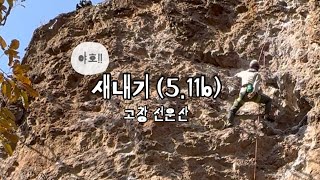
| Freshman/새내기 | 5.11b | 5.11b | 17 m | Soksal/속살바위 | 2012 Climb p.105 |
| JCC3 | 5.11c | 5.11c | 21 m | Soksal/속살바위 | 2012 Climb p.105 |
Advanced: 7a to 7c+ (YDS 5.11d–5.13a)
Locate the Korean names and exact lines for ZOO and Puzzle before choosing a project.
| Route | Grade | YDS | Length / pitches | Sector | Notes |
|---|---|---|---|---|---|
| ZOO | 5.12a | 5.12a | 20 m | Soksal/속살바위 | 2012 Climb p.105 |
| Puzzle/수수께끼 | 5.12b | 5.12b | 19 m | Soksal/속살바위 | 2012 Climb p.105 |
Expert: 8a and up (YDS 5.13b and up)
Tugu has historical named hard routes. Verify starts, extensions and hardware against a current topo.
| Route | Grade | YDS | Length / pitches | Sector | Notes |
|---|---|---|---|---|---|
| Crazy Man/크레이지맨 | 5.13b | 5.13b | 16 m | Tugu/투구바위 | 2012 Climb p.106 |
| Automatic/오토매틱 | 5.14a | 5.14a | 20 m | Tugu/투구바위 | 2012 Climb p.106 |
Watch the climbs
Freshman / 새내기 5.11b · Soksal · Iron LEE

Where to look things up
- 2020 Gochang visit: sector styles; do not copy its prices or bus numbers.
- Gochang timetable and official park page: return transport, local rules and temple contacts.
- Guidebooks: Grades and route counts here come mainly from online databases; the guidebook is the authority.
- Climb: Rock Climbing in Korea, Dong-il Ryou and Jonn Jeanneret, Outdoor Global, first edition 2012; English descriptions with Korean place and route names. Seonunsan occupies printed pages 102–111. The route selection comes directly from that chapter; the historical Dosol table is not a current access list.
- Compare Gochang Halmae-bawi for another sport-climbing option with more vertical terrain.