🌏 繁體中文版
Yuseondae (유선대, also Yoosun-Dae or Youseon-dae) rises above Biseondae in the same approach area as Janggunbong. The first question is what you want from the day: ridge travel with broad Seoraksan views, or more time climbing cracks and slabs?
This guide compares Longing for Two with Yoosun AB and separates route versions so the whole team can choose a suitable multipitch objective.
What kind of crag
The 2012 Climb guide describes southwest-facing granite trad climbing on slabs, cracks and chimneys. It lists wall routes such as Yonghwa A/B, Insugil and Yuseon B/C/D without providing pitch counts for every line. A total length is not enough to infer pitches or rope requirements.
그리움 둘 (Longing for Two) is the ridge alternative. Its MP route page gives 5.8 and 11 pitches, with a short rappel along the way. The low grade does not mean simply climbing upward until the end. It is a useful comparison for teams already competent at multipitch systems who want ridge movement and scenery.
Yoosun AB is a more clearly defined six-pitch wall objective. The MP pitch description moves through a bolt-protected vertical start, a chimney, a corner crack and slab before joining the ridge. Bolts on pitch one do not make the entire route a quickdraw-only climb. Bring suitable removable protection and decide how you will finish after joining the ridge.
When to go
The southwest aspect comes from the 2012 guide; account for afternoon sun and water in warm weather. Ridge travel changes your exposure to both sun and wind. For a first visit, consider a dry day in June or September–October, then finalize around annual access, rain and temperature rather than treating these as fixed permitted dates.
Longing for Two involves repeated rope transitions. Belay waiting can be cold even when hiking is comfortable; on hot days water needs extend beyond your own climbing time. In autumn, include the intermediate descent, exit finding and return to Sogongwon in the daylight budget. Use the KNPS control page for the approach trails.
Getting there
Public transport
Base yourself in Sokcho and take bus 7 or 7-1 to 설악산소공원 (Seoraksan Sogongwon). The official Sokcho timetable, consulted in October 2026, lists services by Gangwon Passenger (강원여객) and Donghae Sangsa (동해상사). The Korea Tourism Organization also gives these buses from the Sokcho Intercity Bus Terminal. Select the stop for your accommodation and direction in the city system; timetable endpoint times are not departures from your stop or return times from the park.
Walk from Sogongwon toward Biseondae, then toward Madeungnyeong (마등령). The 2012 guide distinguishes Yuseondae from Janggunbong’s Southwest Wall and the Geumganggul cave branch: following the tourist trail all the way to the cave is not the Yuseondae approach. Identify the final branch with the selected route topo and permitted access rather than relying on old tree ribbons or faded arrows.
Driving
Navigate to 설악산소공원, the Seorak-dong entrance on the Sokcho side. A generic search for Seoraksan may send you toward a different valley. Driving gets you to the walking approach, not to the base of the cliff.
Parking
Use the entrance-area car parks and follow the manager's current arrangements. Confirm access and collection times before leaving a car for a long multipitch day. Leave room in the schedule for walking back and reaching the car; a distant lower parking space can change the return plan.
Rules before you go
Before booking a climbing day, tell the Seoraksan office (+82-33-801-0900) your date, 유선대 / Yuseondae, exact route and team size. Use the KNPS rock-use service to arrange the applicable process and confirm your authorization. The generic portal alone does not establish the current quota or procedure for every named wall; visitors without Korean mobile verification should clarify their application method with the office.
Check the official control page for the approach as well as the rock. In October 2026 its extracted notice still carried an April reference date, so it should not be read as confirmation of today's conditions. A hiking trail being open does not authorize every climbing branch; annual fire-prevention dates are not a universal rock-climbing calendar.
Clarify whether your application concerns a 유선대 wall route or the 그리움 둘 ridge, and give the manager the complete name. Tourist access to Biseondae does not establish a single rule for all climbing branches.
The 2012 guide warns about hardware placement; its old descriptions are not present-condition guarantees. The MP Longing for Two page also emphasizes identifying the right start. Save entrance photographs offline and agree on the route with your partner. Differing starts, linkups and pitch combinations should not be merged into one descent plan.
Carry helmets and protection appropriate to the chosen route, and agree on retreat options before starting. Published route lengths are not rappel-rope requirements. In an emergency call 119, as described by the National Fire Agency, and provide the Korean rock and route names. Ask your insurer specifically about trad and multipitch climbing, rescue, medical treatment and repatriation. BMC's policy summary illustrates why activity exclusions and the full policy wording matter; use your own insurer's terms.
Routes by level
YDS and V-grade conversions follow the Mountain Project international grade comparison chart and are approximate; "approx." marks grades the sources give without a/b/c (such as 4 or 5+). The original grade is the one that counts.
The original sources use YDS. Values are retained without reverse-converting to French grades; aid suffixes are kept.
Beginner: up to 6a (YDS 5.10a and below)
For ridge scenery, consider Longing for Two. A partner who can climb 5.8 but has not mastered transitions and descents should practice those systems somewhere with easier retreat first.
| Route | Grade | YDS | Length / pitches | Sector | Notes |
|---|---|---|---|---|---|
| Longing for Two / 그리움 둘 | 5.8 (hardest) | 5.8 | 11 pitches; total length from selected topo | Ridge | Grade from MP route page alone; includes an intermediate rappel. |
Intermediate: 6a+ to 6c+ (YDS 5.10b–5.11c)
Yoosun AB provides a six-pitch style comparison. Yonghwa A/B come from an older table with lengths but no usable pitch descriptions, so obtain the actual route topo before choosing either.
| Route | Grade | YDS | Length / pitches | Sector | Notes |
|---|---|---|---|---|---|
| Yoosun AB | 5.10b (hardest) | 5.10b | 6 pitches; listed lengths total 155 m | Southwest Face | Single MP source; last pitch joins Longing for Two, requiring a finish plan. |
| Yonghwa A / 용화 A | 5.10c | 5.10c | 120 m; pitches not listed | Southwest Face | Single 2012 source; original length has an asterisk. |
| Yonghwa B / 용화 B | 5.10c | 5.10c | 125 m; pitches not listed | Southwest Face | Single 2012 source; original length has an asterisk. |
| Insugil / 인수길 | 5.11a | 5.11a | 130 m; pitches not listed | Southwest Face | Single 2012 source; total length is not descent-planning data. |
Advanced: 7a to 7c+ (YDS 5.11d–5.13a)
The sources used here do not establish a route in the 5.11d–5.13a band. Do not borrow a similarly named line from another wall. The useful distinction here is ridge travel versus wall climbing.
Expert: 8a and up (YDS 5.13b and up)
The sources used here do not establish a route at 5.13b or above. If that is your main sport-climbing target, compare other areas and consider Yuseondae as a different kind of day.
Watch the climbs
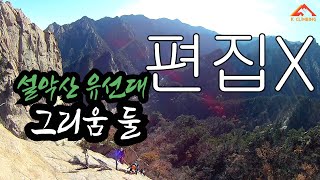
Longing for Two / 그리움 둘 5.8 · 50 minutes of lead POV, unedited · 맥클라이밍


Where to look things up
- Transport: Sokcho's official timetable for the two operators' 7/7-1 services; select your boarding stop separately.
- Park management: KNPS control notices and rock-use applications, with direct office confirmation for the selected rock and route.
- Online route records: Mountain Project's Seoraksan index; useful for comparing current entries, but not an access authority.
- Guidebooks: Grades and route counts here come mainly from online databases; the guidebook is the authority. The tables distinguish the 2012 guide from other accounts; use a current route-specific topo.
- Climb: Rock Climbing in Korea, Dong-il Ryou and Jonn Jeanneret, Outdoor Global (아웃도어글로벌), first edition November 2012. English descriptions with Korean place and route names; selected roped crags across Korea. The Seoraksan section is on printed pages 196–205. It does not supply current access or hardware guarantees.
- Individual route pages: Longing for Two and Yoosun AB each have their own description. Match names and endpoints before using a topo.
References
- Climb: Rock Climbing in Korea
- Sokcho official bus timetable
- Korea Tourism Organization: National park trails
- Mountain Project: Seoraksan
- KNPS control information
- KNPS rock-use service
- National Fire Agency: EMS
- BMC insurance summary
- Mountain Project: Longing for Two
- Mountain Project: Yoosun AB
- Mountain Project: International climbing grade comparison